In short: You do not need to give an AI feature all of a business's data. For most suggestions "who did what and when" is enough; the mail body, the file contents or the internal note itself is not needed. This is the difference between outline and content, and it is the most practical way of minimising data.
What is an outline and what is content?
Content is the thing itself: the body of a mail, the inside of a file, the text of a note. An outline is information about it: from whom to whom, on what date, on what subject, how many attachments. For a mail the outline says "Ms Ayşe sent a quote request on Friday, not yet answered"; the content is the whole text of the mail.
Many business questions need no content and are answered with an outline: "Which customer is waiting for a reply?", "Which quote has been waiting for weeks?", "Which meetings are there this week?" For these, showing the AI the text of the mail is needless.
Why does this difference matter?
For three reasons:
- Risk. Every piece of information you give a model goes to a provider and carries a chance of leak or misuse. Information you did not give cannot leak.
- Cost. Less data means a smaller context for the model; that is cheaper and usually faster.
- Focus. Too much context can distract a model; irrelevant information can lower quality.
How does B.O.S.S. apply this principle?
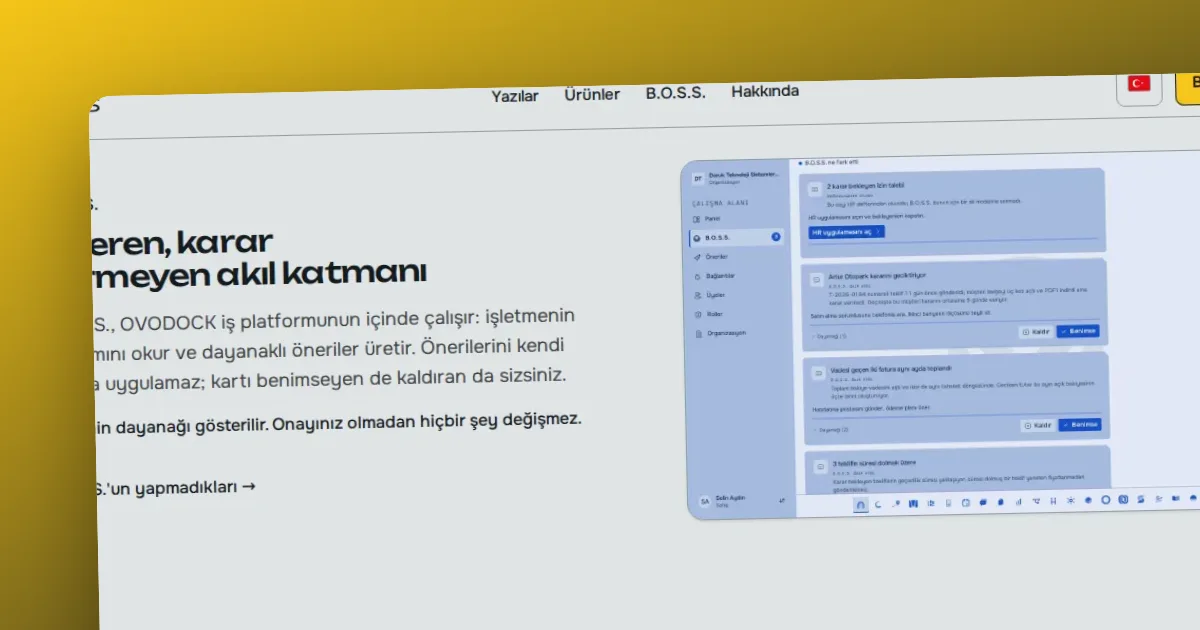
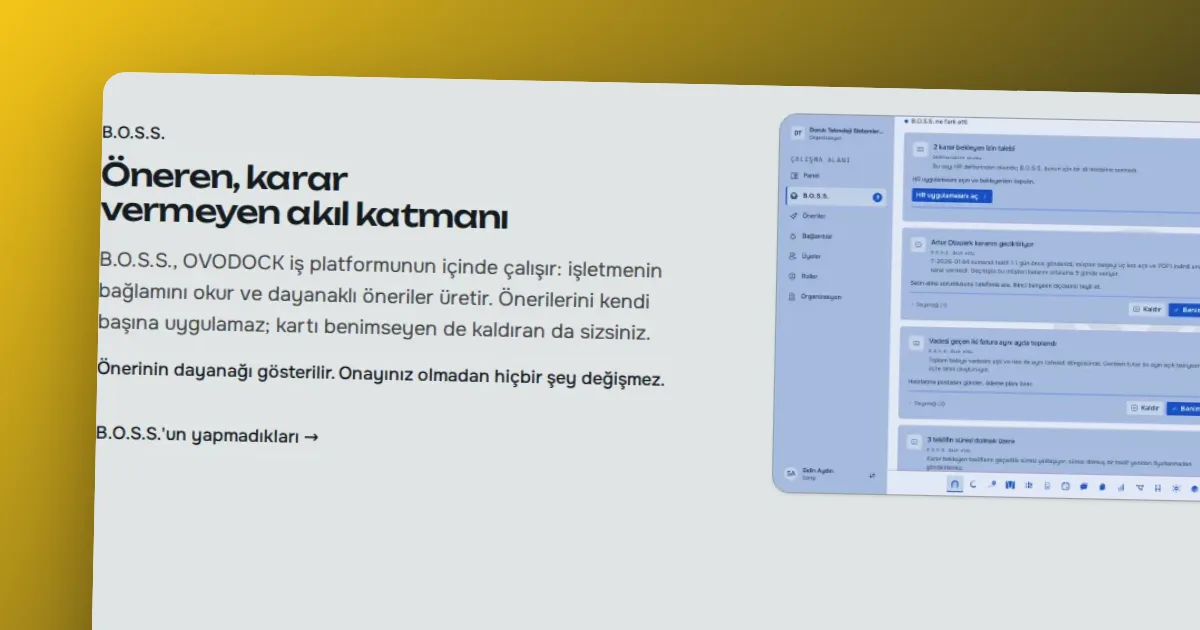
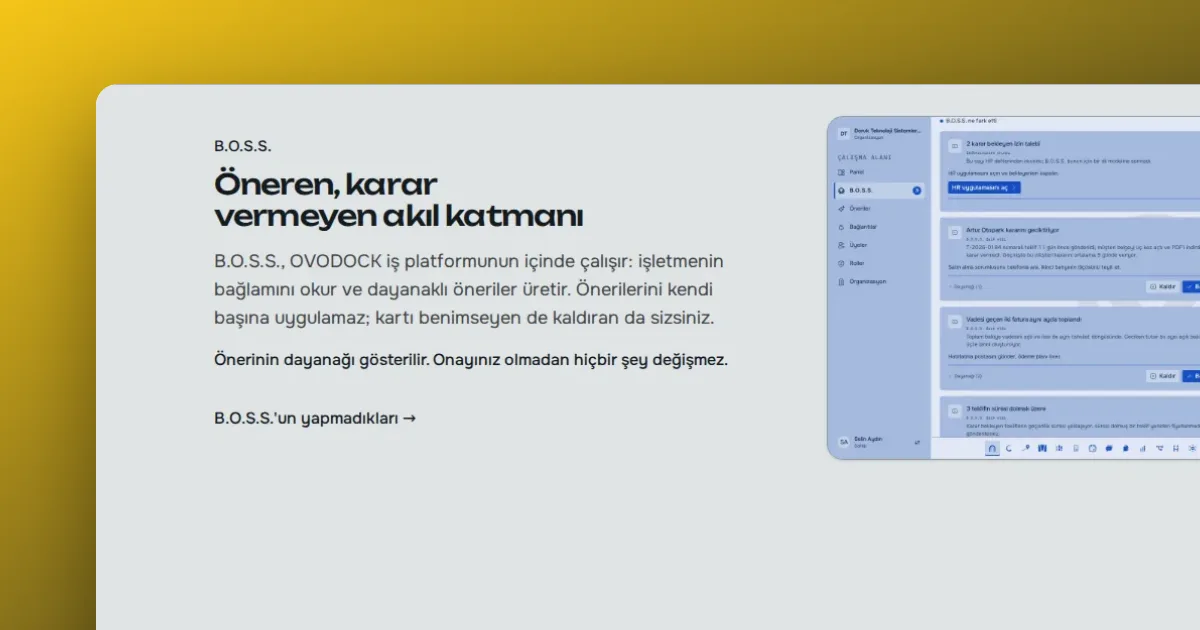
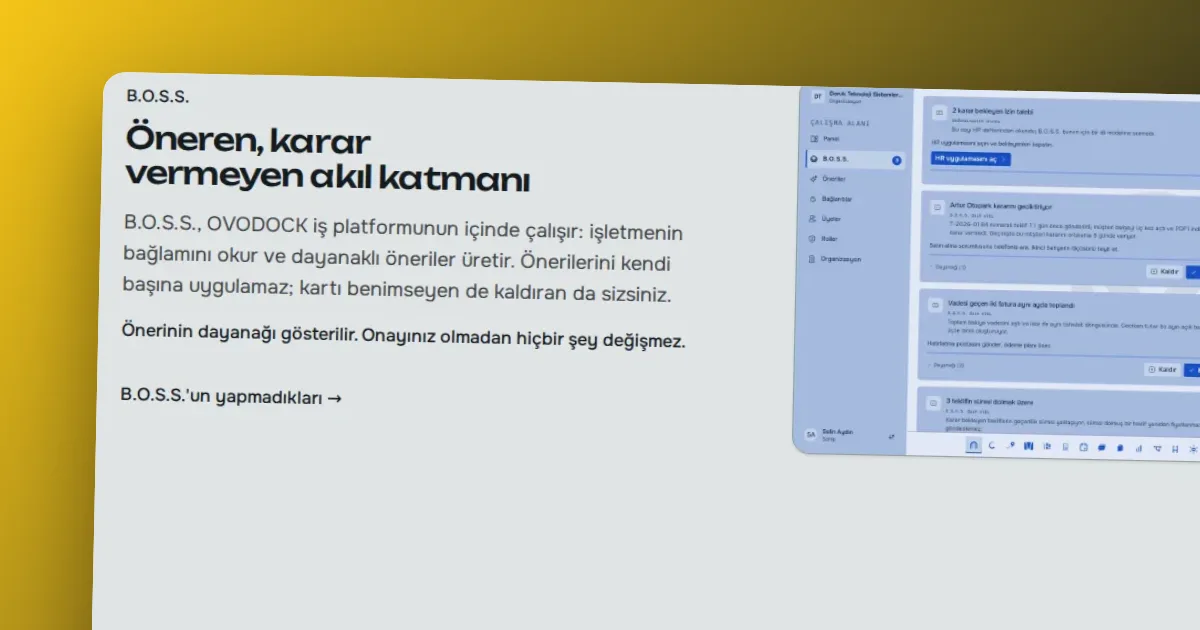
B.O.S.S. sends the model a slice: recent documents, upcoming and pending work, contacts of the last six months and facts in memory. Internal notes, cost, profit and file contents are not sent. File content is used only when you ask for a summary of a file; that is, content goes to the model through a user action and only for that file.
| Data | In B.O.S.S. | Reasoning |
|---|---|---|
| Document outline | Sent | Knowing which document changed when is enough |
| Pending work | Sent | Needed for a suggestion |
| Contacts of the last six months | Sent | To see close relationships |
| Facts in memory | Sent | One-sentence notes, visible and deletable |
| Internal note | Not sent | Not essential for a suggestion, sensitive |
| Cost and profit | Not sent | Sensitive, not essential for a suggestion |
| File content | Only if you ask | The decision is yours |
What does it cost?
To be honest: data minimisation has a cost. Less context sometimes means a less accurate suggestion. A suggestion that does not see the content may miss the tone of a conversation or a subtle detail. This is a trade-off and we chose in favour of less data, because a wrong suggestion is trouble but data that went to the wrong place cannot be taken back.
A warning too: although the slice that goes to the model is narrow, the terms of providers on free tiers apply and a provider may use content to improve its own services. Data minimisation does not remove this risk; it only reduces it.
How do you apply it in your own AI features?
- Write down the question. What question do you want the AI to answer?
- Decide the necessary data. What information is essential to answer this question?
- See whether an outline is enough. Often it is.
- Make content the last resort. If content is needed, tie it to a user action.
- Keep sensitive areas out. Exclude areas such as cost, profit, internal notes and identity data from the start.
- Leave a way to turn it off. The user should be able to take an application out of the AI's field of view.
Why does a way to turn it off matter?
The last link of data minimisation is the user's control. In B.O.S.S. which application is in its field of view is written on screen and can be turned off per application with one click. The records of an application you turn off do not go to the model. This is the practical counterpart of the principle of "not working in secret".
Common mistakes
- "Let us give everything just in case." Too much data means too much risk.
- "We only send it once." Data that has gone once cannot be taken back.
- "The provider is safe anyway." Do not make that assumption without reading the provider's terms.
Ready? Read OVOLABS's model card.