 TR
TR EN
ENWhat we are working on, and how we think about it.
OVOLABS is the AI and research arm of OVOKODO A.Ş. This page is a window into the work: it describes what exists today, and promises nothing beyond that.
Verified usage measurements have not been published yet. This is not a live counter.
SUGGESTIONS GENERATED
—
Measurement not published.
DROPPED AT THE GATE
—
Measurement not published.
ADOPTED BY A PERSON
—
Measurement not published.
COST PER PASS
—
Measurement not published.
Example notebook: the experiments, charts and results below illustrate the process; they are not live usage or verified performance data.
Labs, screen by screen
Seven screens: experiments, measurement, decision records, model card, limits, changelog and roadmap.
Mandatory grounds
If a suggestion cannot say which record it came from, it is dropped at the gate.
Dropped at gate
31%
Adoption
2×
Run cost
How many records the pass reads and how many suggestions it produces; value per token.
Cost per pass
$0.04
Per suggestion
$0.006
Proposal summary
A long proposal reduced to one paragraph; does it reduce the questions asked afterwards?
Measurement
running
First signal
positive
Voice input
Opening a record by speaking in the field. Error rate in noisy environments was not acceptable.
Error rate
18%
Decision
postponed
Every experiment opens with a question and closes with a measurement. Shelved ones stay visible too.
Principles
Four rules every experiment is checked against before it ships.
01
Grounds or nothing
A suggestion that cannot name its source does not exist.
02
Measure before shipping
No capability enters a product without a number next to it.
03
Write the decision down
Chosen, rejected and shelved: all in numbered records.
04
A person acts
The system proposes; it never applies its own suggestions or sends anything on your behalf.
Diagram: four research fields — LLM, Agents, Voice, Vision. The B.O.S.S. node is filled and linked to an OVODOCK label: the one piece of work in production today.
Four fields on the agenda; the one in production is marked. The map is an inventory, not a claim.
Running in production
B.O.S.S.
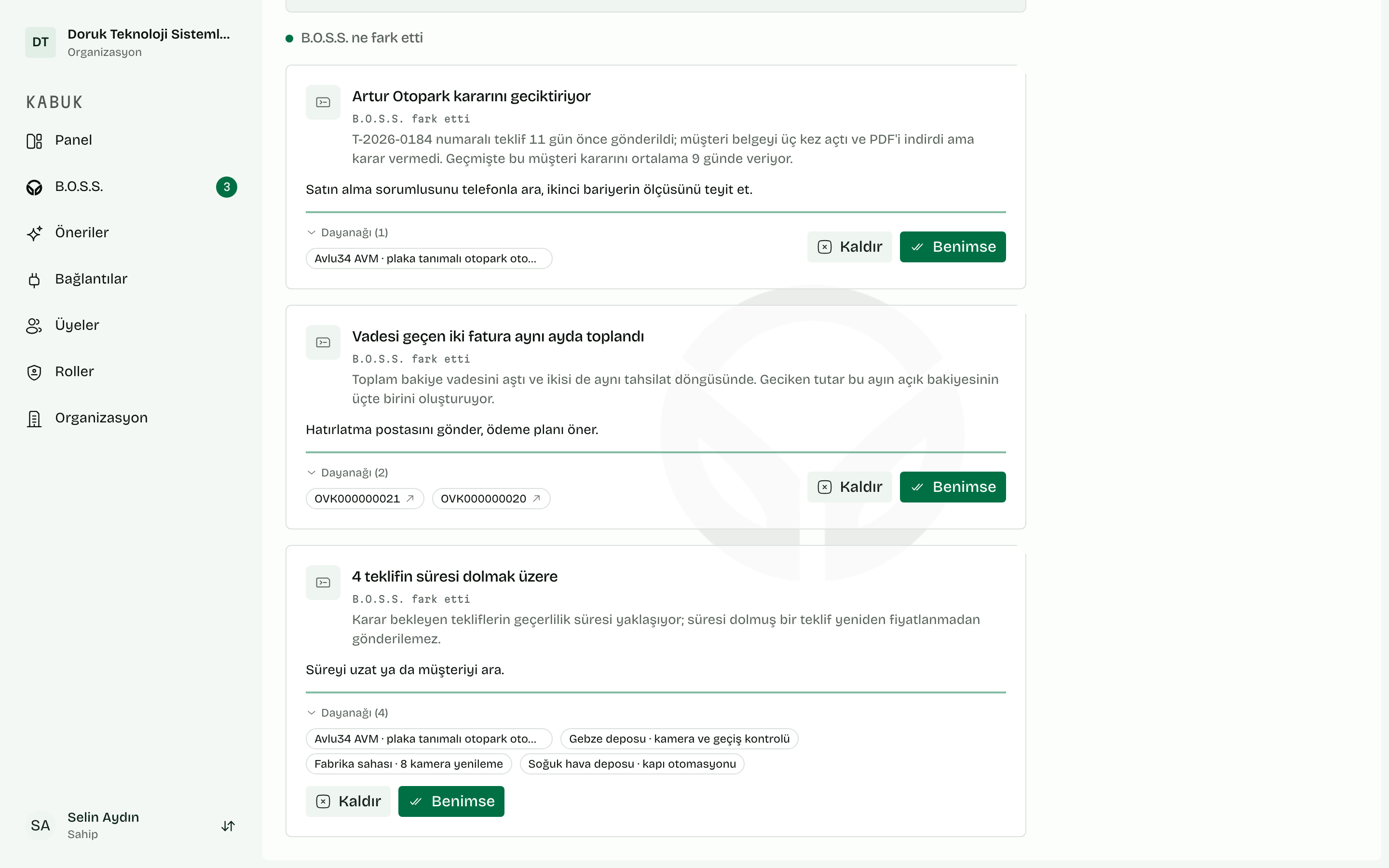
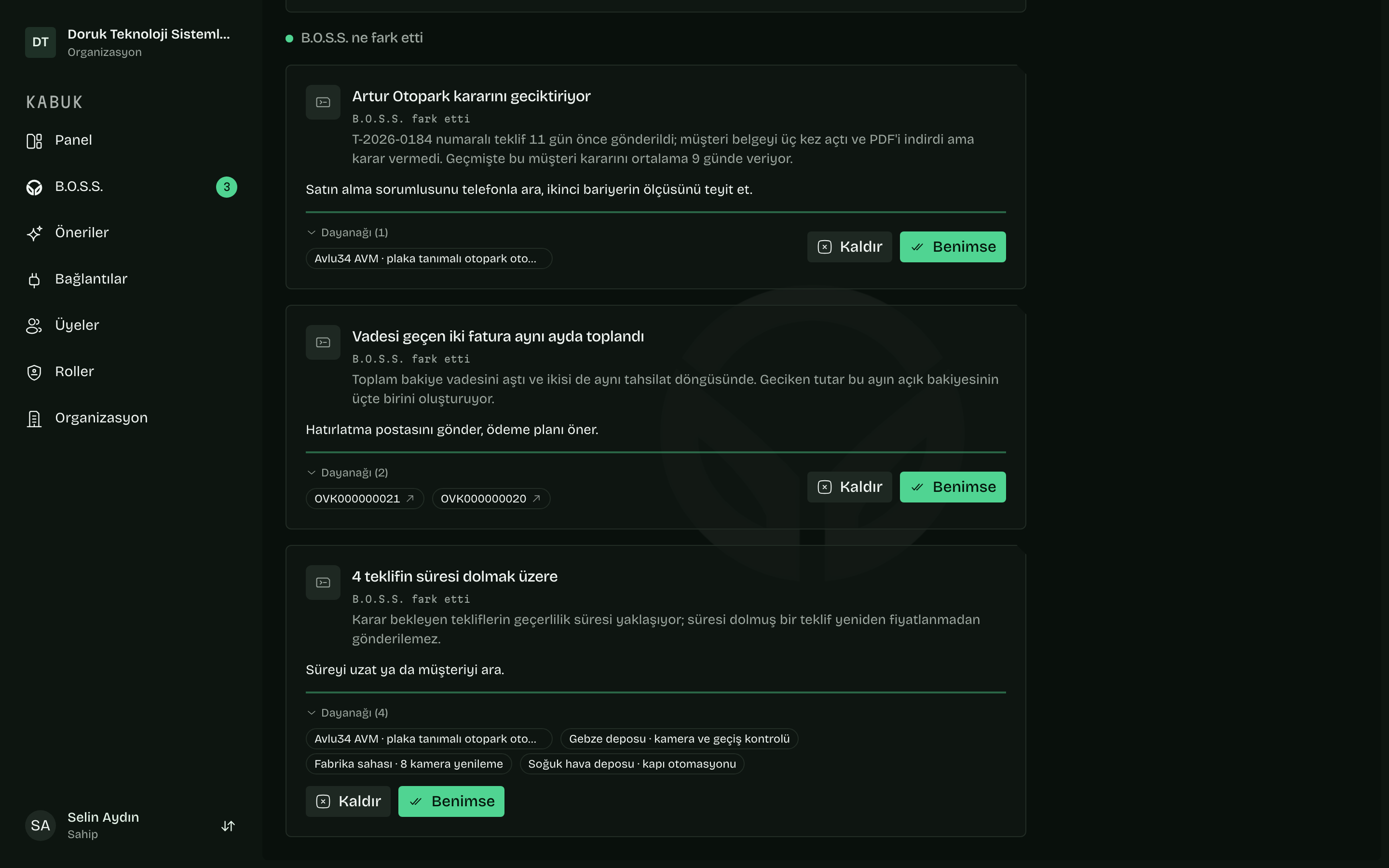
An LLM-backed reasoning layer that runs inside the Ovodock business platform. It reads the context a business operates in and produces suggestions with the evidence they rest on. It never applies its own suggestions: a person adopts or dismisses every card.
From the product, as it is
B.O.S.S. is on a real screen today.
This image is not a concept: it was taken from the actual B.O.S.S. suggestion screen inside OVODOCK — with its evidence and its dismiss button. The research described here runs there.
Research notes
2026-09-02
The tenant boundary in two layers: the application alone wasn't enough
How we work
Our engineering culture fits into two sentences: every claim gets measured, and every change ships through the same automated checks. What does not work is not written about; what does work is written about together with its limits.
Research agenda
The areas we are working on — this is an agenda, not a product line:
- LLM integrations
- Agent systems
- Speech (TTS/STT)
- Vision
CORRECTIONS & QUESTIONS
If a sentence or a number is wrong, write to us.
The contact form goes straight to the Labs team; there is no mailing list.
Get in touchWHERE IT RUNS: DOCK
B.O.S.S. is the layer this Labs measures.
Every gate, limit and record here applies to the suggestions Dock shows on your customer, proposal and invoice cards.
See B.O.S.S.