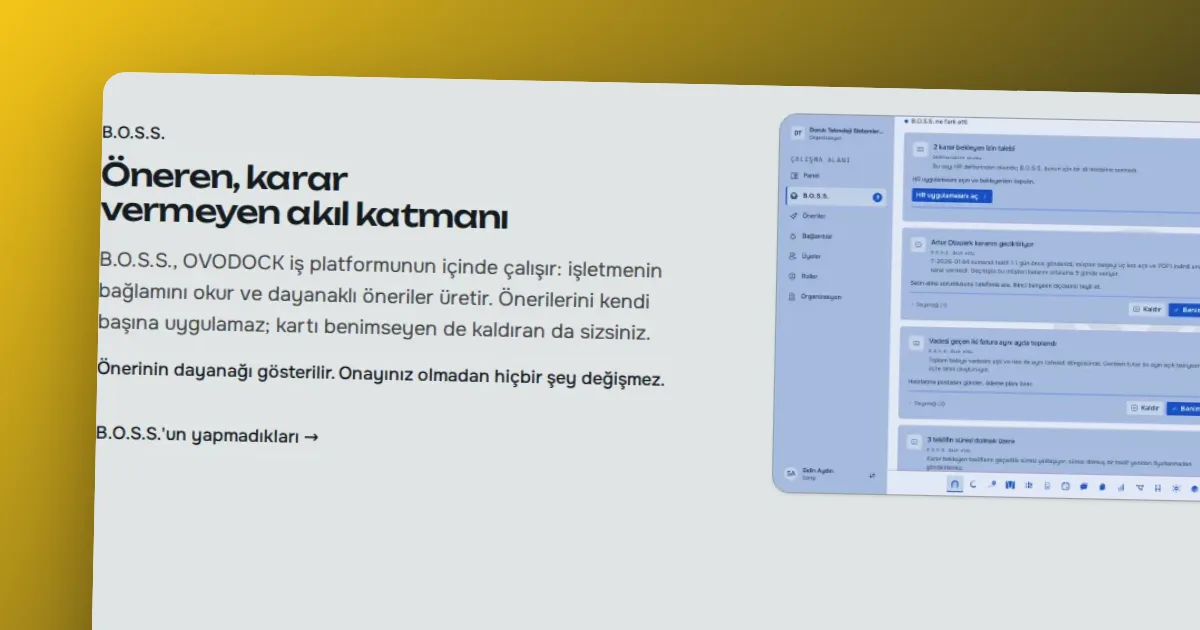
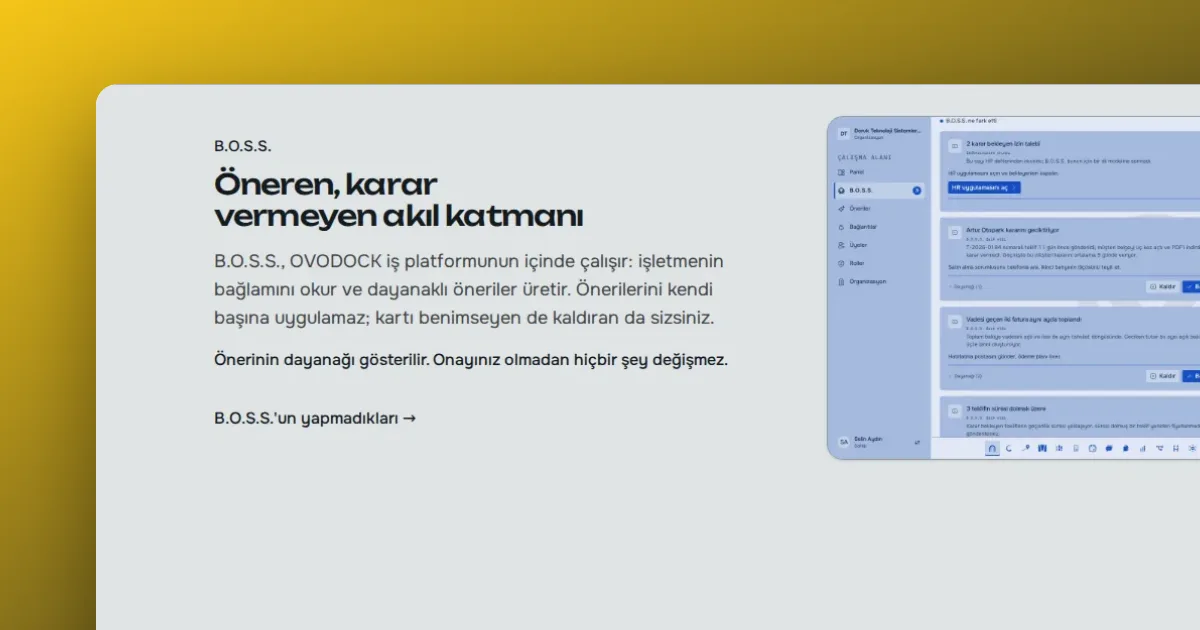
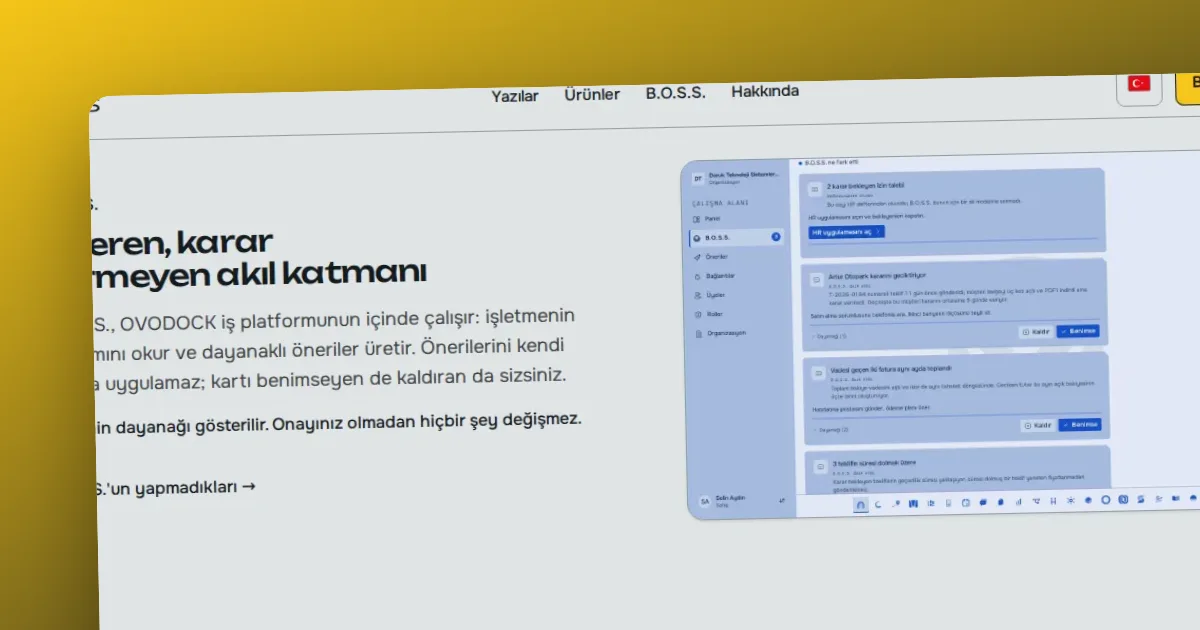
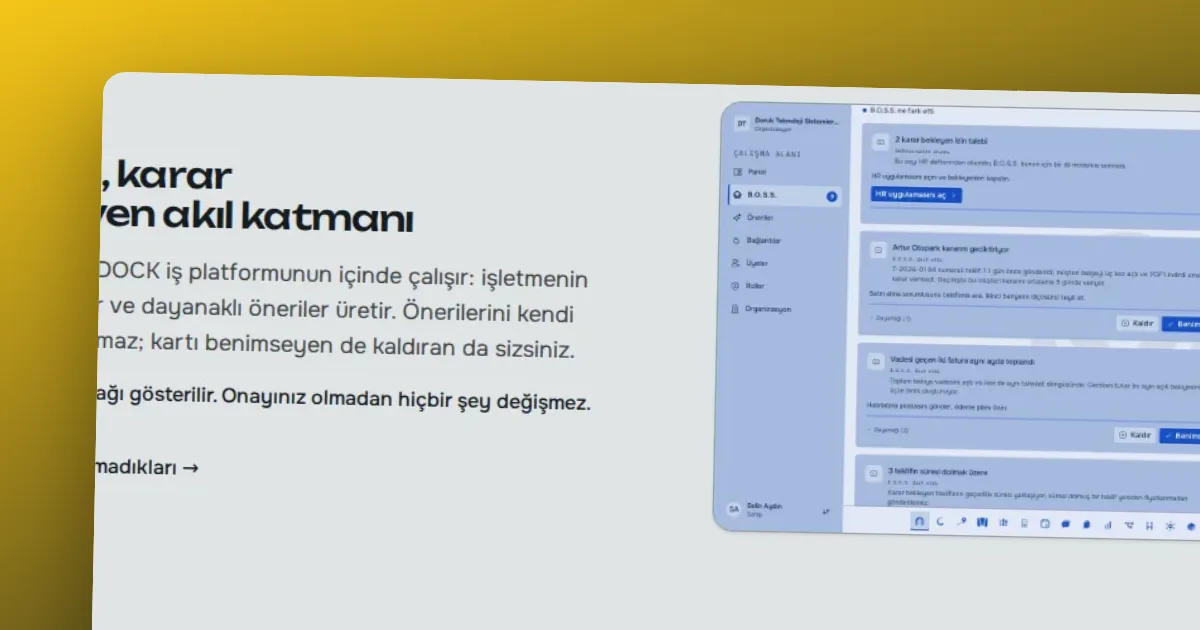
In short: The right line for leaving a decision to AI depends on the decision's reversibility, the cost of a mistake and who will answer for it. Decisions that cannot be undone, are expensive or create responsibility towards someone must stay with a person. B.O.S.S. draws this line at its hardest point: it produces suggestions and applies nothing on its own.
Why does the question matter?
AI features are spreading fast and every business meets the same question: "Can this job be left to AI?" The answer is rarely "yes" or "no"; it is which job, under what condition, with what guardrail. Drawing the line wrongly has two directions: draw it too wide and a wrong automatic decision does harm; draw it too narrow and you see no benefit from AI.
A three-question framework
For each decision ask three questions:
- Can it be undone? If it turns out wrong, can I fix it? Deleting a draft can be undone; recalling a mail sent to a customer is impossible.
- What is the cost of a mistake? What does a wrong decision cost me: a minute or a customer?
- Who answers for it? Is there a person responsible for this decision? Who will say "I did this" to a customer, an employee or an institution?
If you can answer all three with "easy, cheap, me", the decision can be left to AI, still with oversight. If even one is "cannot be undone, expensive or the responsible person is unclear", the decision must stay with a person.
Decision types and the suggested line
| Type of decision | Can it be undone? | Suggested |
|---|---|---|
| Summarising a list | Yes | AI produces, a person reads |
| Writing a draft | Yes | AI suggests, a person edits |
| Ordering records | Yes | AI suggests, a person approves |
| Sending mail to a customer | No | A person sends |
| Setting a price or discount | Partly | A person decides |
| Deleting a record | Often no | A person deletes |
| Making a payment | No | A person makes it |
| Deciding about a person | Large effect | A person decides |
How does B.O.S.S. draw the line?
B.O.S.S. is the harshest application of this framework: it does nothing on its own. Nothing the model writes is executed; mail, quotes or messages are not sent by AI, and the sender is always a user. The grounds of a suggestion are shown; the person adopts or dismisses a card. This is the product reflection of the choice not to leave any "cannot be undone" decision to AI.
This hard line has a cost: speed. Every suggestion needs a person's attention and human attention is scarce. We accept that cost, because a wrong automatic decision is far more expensive than the trouble of reading a card.
Where should automation be used?
AI and rule-based automation are different things. You write a rule and it runs the same every time; it is predictable and checkable. Automation suits jobs that must be the same every time, are reversible and cheap (such as sending a notification). For jobs needing judgement, an AI suggestion suits. The two should not be mixed: doing automation with AI means automating unpredictable behaviour.
Common mistakes
- Confusing reliability with fluency. AI speaks fluently; being fluent does not show it is right.
- Leaving oversight for later. "Let us run it first and check later" does not work for mistakes that cannot be undone.
- Leaving accountability unclear. If it is unclear who made the decision, whose mistake is it?
- Drawing the line once and forgetting it. AI features change; review the line regularly.
Applying this to your own business
- Write down the jobs you are thinking of leaving to AI.
- Answer the three questions for each job.
- Start with a small trial for the jobs where you can say "yes" to all three.
- Record what went wrong in each trial.
- If unsure, start with a suggester; let the decision stay with a person.
Ready? Read OVOLABS's principles.