In short: B.O.S.S. runs one round each morning (10:00 Turkey time) and checks for new events every fifteen minutes. At most three model rounds are run per day for one organisation. If nobody looks at the suggestions for fourteen days, the rounds stop. Nothing the model writes is executed; you are the one who adopts or dismisses a card.
The round schedule
B.O.S.S. works in two rhythms:
| Rhythm | When | What it does |
|---|---|---|
| Morning round | Every morning, 10:00 Turkey time | Compiles the context, asks the model, writes grounded suggestions |
| Event check | Every fifteen minutes | Looks for new events; starts a round if needed |
At most three model rounds are run per day for one organisation. This limit bounds both cost and noise: a suggestion changing many times through the day lowers the user's trust in it.
Why can rounds stop?
A round is not run in two cases:
- If nobody is looking. If nobody looks at the suggestions for fourteen days, the rounds stop. Calling the model for suggestions nobody reads is wasted cost.
- If the daily token cap is full. The platform has a daily token cap. When it fills, that day's rounds are not run and it continues the next day.
When you start looking at suggestions again, the rounds run again.
Is anything the model writes executed?
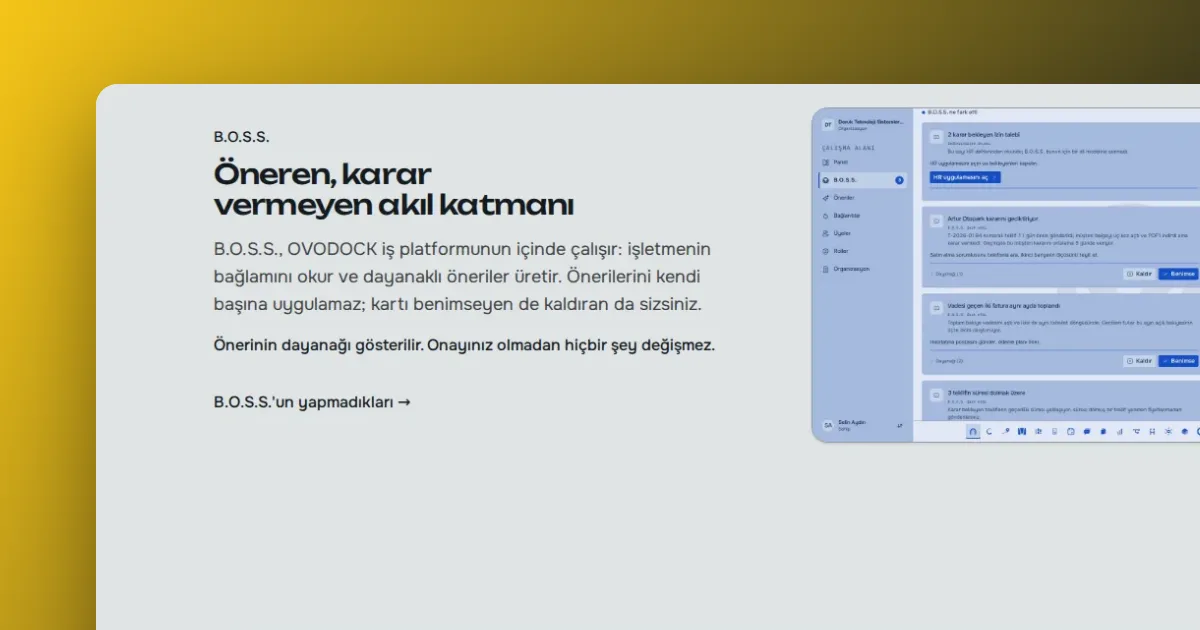
No. Nothing the model writes is executed. B.O.S.S. does not apply its suggestion on its own: you are the one who adopts or dismisses a card. If it suggests an application you do not use, adopting the card opens that application free for three days; nothing is opened before the card is adopted.
The only work that runs without asking is each morning's summary notification: it tells you the day's suggestion summary and does nothing else.
What does B.O.S.S. not do?
| It does not | Why it matters |
|---|---|
| Send mail, a quote or a message on its own | The sender is always a user |
| Delete or change records | The decision is the person's |
| Free-text chat | A command is chosen in chat; free text does not go to the model |
| Write a sentence without grounds | A suggestion without grounds is not saved |
| Work in secret | Which application it can see is written on screen and can be turned off with one click |
| Keep a conversation history | The text of a chat is not stored |
Why these limits?
Each limit closes a risk. At most three rounds a day bounds cost and noise; the fourteen-day silence rule bounds wasted model calls; the token cap bounds the platform's total cost. The rule of applying nothing on its own is the most important: AI can be wrong and a business should not pay the price of its mistake.
What do these limits mean for you?
- Suggestions come in rounds, not at every moment; if you have an urgent matter, trust your own follow-up, not B.O.S.S.
- If you do not look at suggestions for a while, B.O.S.S. stops; this is not a fault.
- You always make the decision; no record changes until you adopt a card.
Measurement
The round times and limits on this page are today's behaviour. We do not yet publish usage measurements such as the number of suggestions produced, the number of rounds dropped at the gate and the share of suggestions a person took ownership of, as verified figures; the counters on the OVOLABS showcase therefore stand at "measurement not published".
Ready? Take a look at OVOLABS.